A closer look at what January’s order activity says about fleet behavior in early 2026
FTR reports that preliminary North American Class 8 net orders totaled 32,500 units in January 2026, down 24% month-over-month but up 27% year-over-year. While the headline number shows improvement versus early 2025, the broader context suggests this movement reflects timing and deferred decisions rather than a clear demand inflection.
January marked the second consecutive month of year-over-year growth, the first such stretch since spring 2024, and orders came in well above the 10-year January average of 26,300 units.
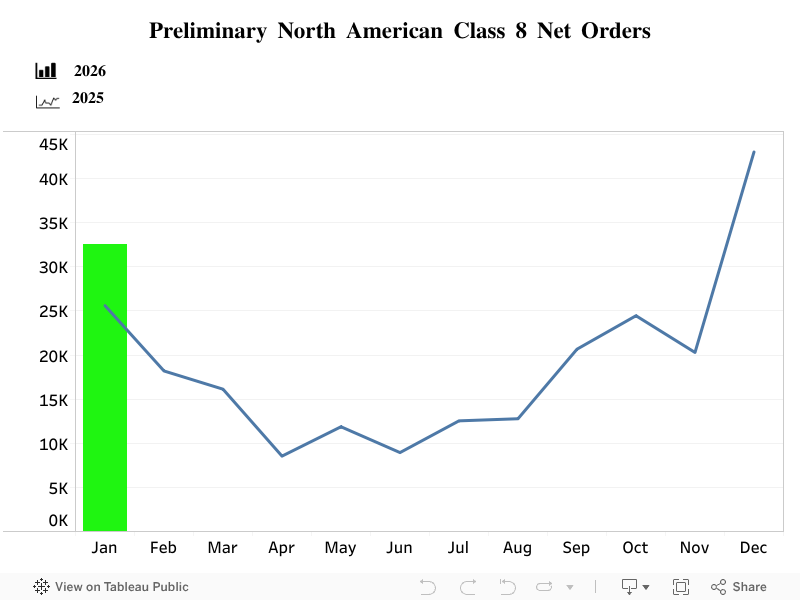
Sequential Softness, Annual Improvement
The month-over-month decline was concentrated in the on-highway segment, while both on-highway and vocational markets supported the year-over-year gain. This mixed pattern reinforces a cautious but incremental return to the market rather than a broad-based acceleration in demand.
Seasonally, January order activity can be volatile, making year-over-year comparisons more instructive. Even so, the data point to stabilization, not expansion.
Replacement Demand, Not a Cycle Shift
Despite January’s improvement, cumulative orders for the 2026 order season (September–January) remain 13% below last year’s pace. That gap underscores the view that recent strength reflects fleets executing deferred replacement demand, rather than signaling a sustained cyclical recovery.
Greater clarity around tariff-adjusted pricing and improved visibility on EPA 2027 NOx regulations likely encouraged fleets to move forward with purchases that had been delayed through much of the fall, pulling order activity into late 2025 and early 2026.
Capital Discipline Still Governs Fleet Decisions
As Dan Moyer, senior analyst for commercial vehicles at FTR, explains:
 “Some stabilization and improvement in the freight market since late 2025 also may have provided modest support at the margin, but fleet profitability and capital discipline remain binding constraints. Purchasing behavior continues to be replacement-driven with only modest early EPA 2027 influence. Lingering downside risks include fragile freight fundamentals, elevated cost pressures, geopolitical uncertainty, and broader macroeconomic risk.”
This perspective reinforces that while recent order gains are constructive, fleets remain cautious and highly selective with capital commitments.
What a Durable Recovery Would Require
For Class 8 orders to move beyond stabilization, several conditions would need to materialize:
- Sustained year-over-year order growth through 2026
- Meaningful improvement in freight demand and pricing
- Clear evidence of improving fleet profitability
- Reduced macroeconomic and geopolitical uncertainty
Until those signals emerge, order activity is likely to remain uneven and replacement-focused.
Bottom Line
January’s Class 8 order data suggest the market is stabilizing after a prolonged downturn, supported by improved regulatory and pricing clarity. However, the fundamentals needed for a durable recovery are not yet in place. Read more: https://www.ftrintel.com/class-8-truck-orders
Final January order data will be released mid-month as part of FTR’s North American Commercial Truck & Trailer Outlook, which will provide additional confirmation.

Want ongoing coverage and forecast insights?
FTR’s Commercial Truck & Trailer Outlook delivers monthly forecasts, data, commentary, and analysis across the entire freight transportation landscape.
Learn more at: www.FTRintel.com
📝 Want to stay ahead of the curve? Check out all the ways FTR can help!



.png?width=1080&height=1080&name=Registration%20Social%20Media%2011%20(1).png)