Key Takeaways from FTR’s Trucking Market Update (Week of April 13, 2026)
FTR’s latest Trucking Market Update highlights a market that is no longer accelerating—but remains structurally strained. While some indicators show early signs of stabilization, the underlying cost environment and macroeconomic pressures continue to create a challenging operating backdrop for transportation decision-makers.
1. Energy Markets: Stabilization Without Relief
The geopolitical disruption tied to the Strait of Hormuz has shifted from escalation to stabilization—but at persistently high cost levels.
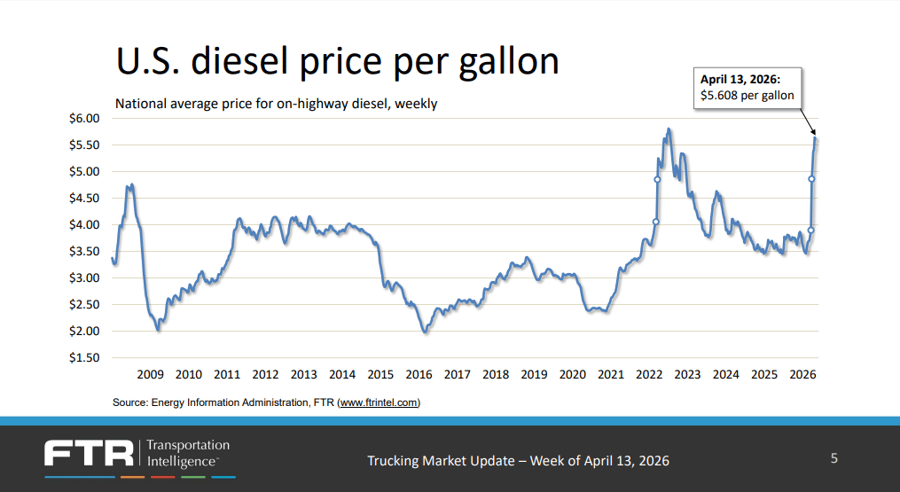
- Diesel prices declined for the first time in 13 weeks, falling modestly to $5.608/gallon
- Crude oil volatility remains elevated, with prices still near $100/barrel despite short-term corrections
- Regional fuel variability is widening, creating uneven cost exposure across networks
Context:
This is not a return to normal fuel conditions—it is a transition from volatility to sustained pressure. For shippers and carriers, this shifts the conversation from “shock response” to cost management strategy.
2. Spot Market: Rates Holding, But Diverging by Equipment
The spot market is beginning to show early signs of cooling in some segments, while others remain structurally tight.
- Dry van and refrigerated rates declined slightly week-over-week
- Flatbed rates increased for the 15th consecutive week, reaching their highest level since mid-2022
- Total spot rates remain elevated, with:
- +26% YoY (all-in)
- +17% YoY (excluding fuel)
Key dynamic:
- Rate increases have largely kept pace with rising fuel costs, especially in dry van
- Flatbed continues to outperform cost inflation, signaling tighter capacity or stronger demand fundamentals
Context:
This is not a demand-driven surge—it is a cost-driven pricing environment with selective capacity tightness.
3. Volume Trends: Rates Are Not Being Driven by Demand
Load activity is not the primary driver of current rate strength:
- Total spot loads increased only ~1.5% week-over-week
- Refrigerated load volumes remain nearly flat year-over-year
Implication:
- The market is being shaped more by cost pressures and supply dynamics than by freight demand growth
Context:
This disconnect reinforces a critical signal:
The current rate environment is fragile, as it lacks strong demand support.
4. Inflation Reaccelerates—Driven by Energy
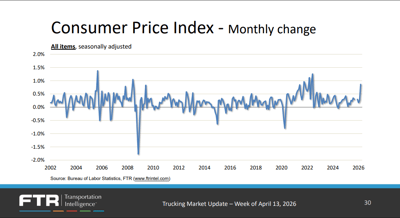 March inflation data reflects a sharp shift:
- CPI increased 0.9% month-over-month (largest since June 2022)
- Gasoline alone accounted for nearly 75% of the increase
- Annual inflation moved up to 3.3%
Key observation:
- Core inflation remains stable—for now—but risk of spillover remains if energy persists
Context:
Energy is once again acting as the primary transmission mechanism into broader economic pressure.
5. Consumer & Industrial Signals: Mixed but Stabilizing
Consumer Side
- Spending remains stable but subdued
- Growth driven primarily by:
- Savings rate is trending near recent lows
Housing Market
- Existing home sales declined 3.5% month-over-month
- Inventory improving slightly but still historically tight
- Mortgage rates eased to ~6.37%, offering marginal relief
Manufacturing
- Core capital goods orders:
- Broad-based gains across metals and machinery
Context:
The economy is not contracting—but it is operating in a low-momentum, uneven growth environment.
6. Inventory Dynamics: A Hidden Structural Shift
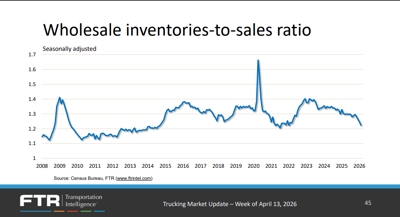 Wholesale inventories are tightening significantly:
- Inventory-to-sales ratio fell to 1.22 (leanest since 2021)
- Electronics and appliances driving the shift:
- +21% sales growth in 4 months
- Likely tied to AI-driven data center expansion
Context:
This is a notable structural development:
- Not cyclical restocking
- Potentially technology-driven demand reshaping freight flows
Strategic Perspective: What This Means
The Market Is Transitioning—Not Recovering
- Volatility has eased
- Cost pressure remains embedded
- Demand signals are still inconsistent
Three Structural Forces to Monitor
- Energy costs → Pricing floor for freight
- Capacity discipline → Especially in flatbed and specialized segments
- Technology-driven demand → Emerging in specific commodity flows
Final Thought
This week’s data reinforces a key theme:
The freight market is no longer reacting to shocks—it is operating within a new cost structure.
For transportation leaders, the focus shifts from short-term reaction to forward-looking strategy around pricing, procurement, and network design.
.jpg?width=356&height=356&name=2026%20FTR%20Conference_SM_Trucking%20Market%20Insight(1).jpg)
Trucking leaders — mark your calendars.
The Truck Track at the 2026 FTR Transportation Conference returns!
📅 August 31 – September 1, 2026
📍 Indianapolis, IN
REGISTER NOW!