



class 8 trucks
forecasting


This was a relatively quiet week for economic data, in part due to the brief federal government shutdown that delayed several key releases. Most notably, the employment situation report—now scheduled for February 11—will include benchmark revisions that are expected to show lower historical employment levels, including in trucking.
Even with fewer releases, the data that did arrive offered important signals about the broader economic and freight environment.
The ISM Manufacturing Index jumped to 52.6% in January, its strongest reading in more than three years and a clear signal of expansion after a prolonged contraction. Components most relevant to freight strengthened meaningfully:

While one month does not establish a trend, the breadth of improvement suggests manufacturing is becoming more supportive of freight activity.
Job openings fell for a third straight month in December, reaching their lowest level since September 2020 and dropping below pre-pandemic norms. This points to slower job growth ahead, driven more by fewer available positions than by rising layoffs.
Unemployment claims edged higher but remain consistent with a labor market that is cooling gradually rather than deteriorating.
 After a sharp decline late in 2025, diesel prices have risen for three consecutive weeks. The national average increased to $3.68 per gallon, driven by extreme cold weather and firmer crude oil prices. While still well below last year’s levels, the rebound adds modest cost pressure back into transportation.
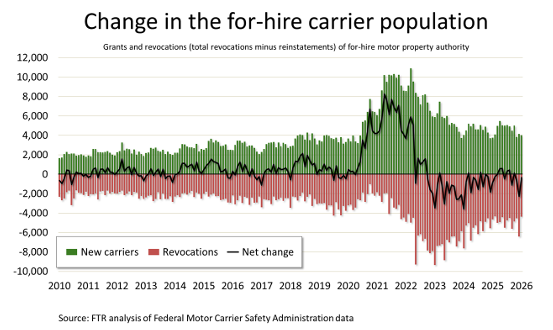
FMCSA data shows that carrier exits slowed meaningfully in January after an outsized decline in December that was largely calendar-driven.
Key developments:
Despite ongoing attrition, the for-hire carrier population remains more than 33% above pre-pandemic levels, reinforcing the view that capacity normalization remains a gradual process rather than an abrupt correction.
New appropriations language formally links English language proficiency violations to out-of-service orders. While enforcement authority is clearer, implementation—particularly at the U.S.–Mexico border—remains uncertain, and legal challenges are possible.
This week’s data points to stabilization rather than acceleration. Manufacturing sentiment improved, labor markets continued to cool in an orderly way, and fleet behavior remained measured. As delayed labor data and additional February indicators arrive, the focus will be on whether these early signs translate into sustained freight demand later in the year.
Learn more about FTR offerings by clicking on the images below.